Solo Set or Sketch: Where Does the Comic Voice Live?
Compare stand-up and sketch by tracing where each comic voice comes from, then use a weeklong writing plan to shape a point of view for either form.
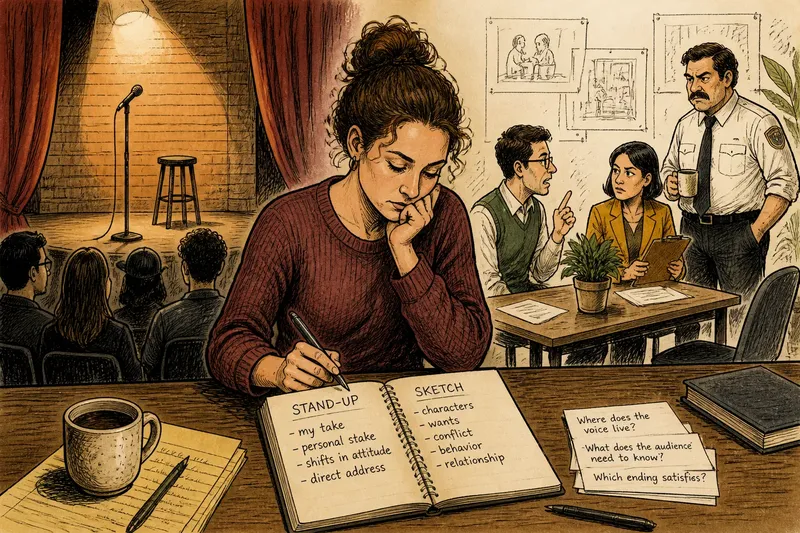
Stand-up puts the comic voice in the performer’s direct address; sketch distributes it among characters, relationships, and the scene they inhabit. If you are deciding whether an idea belongs in a solo set or a sketch, ask where its comic point of view becomes clearest: in one person’s way of seeing, or in what several people do to one another.
That distinction affects more than format. It changes what the audience needs to know, how the performer earns attention, and what kind of ending feels satisfying. A useful way to make the choice is to develop the same premise across a week, then compare the material without forcing either version to win.
Where does the comic voice live in stand-up or sketch?
In stand-up, the performer’s relationship with the audience is part of the material. The comic can speak as themself, adopt a heightened version of themself, or shift between a personal observation and a broader claim. The audience hears a point of view attached to a recognizable speaker, even when the story is exaggerated.
In sketch, the point of view often becomes visible through behavior. A character may insist on an absurd rule, misunderstand a familiar situation, or use authority in a way that exposes the scene’s underlying tension. The performer does not need to explain the joke directly; the audience can infer the comic attitude from the characters’ choices and their effect on one another.
Think of the comic voice as the pattern behind the jokes, not merely a style of delivery. It might be suspicious of social rituals, tender toward people who are bad at their jobs, or fascinated by the gap between what someone claims and what they do. The form should make that pattern easy to perceive.
What should you decide before drafting?
Start with a small, specific premise rather than a topic such as work, dating, or family. Write down what happened, what part strikes you as odd, and what you believe about it. A premise with a clear point of view gives both forms something to build from.
- Name the friction: What expectation, rule, or social habit is being challenged?
- Choose the speaker: Would the idea be strongest as a performer addressing the room, or as a character acting on a belief?
- Find the relationship: If two people are present, what does each want from the other?
- Locate the audience’s knowledge: What can the audience recognize without a long explanation?
- Set the comic distance: Is the material close to the performer’s own outlook, or does it need a character whose behavior can carry the exaggeration?
These are choices, not rules. A personal story can become a sketch, and a scene premise can turn into a stand-up observation. The question is which version makes the comic attitude legible with less explanation.
How can you compare the forms over a week?
Use one premise for both drafts so you are comparing forms rather than unrelated ideas. Keep the writing sessions short enough to leave room for revision, and give each version a different job. The stand-up draft should make a speaker’s thought process compelling; the sketch draft should make a relationship produce visible comic behavior.
Day one: What is the premise?
Write a plain account of the situation, then add the thought that makes it comic to you. Avoid polishing lines. If the premise is “a building meeting that treats a hallway plant like a resident,” note who takes the plant’s needs seriously and why that feels revealing.
Day two: What would the solo performer say?
Draft a short run of direct address. Let the performer describe the situation, disclose their own stake in it, and make the point of view sharper as the material develops. Keep only details that show how this speaker sees the world, rather than details included merely to explain the setting.
Day three: What would the characters do?
Turn the same premise into a scene with distinct wants. In the plant example, one committee member might be eager to assign it a parking space while another tries to follow the building’s actual rules. The comic point should emerge from their decisions and the inconvenience those decisions create, not from a character announcing the premise.
Day four: What information does each version need?
Read both drafts aloud and mark every explanation the audience must receive before the comic idea makes sense. Stand-up may need a concise setup that establishes the speaker’s connection to the situation. Sketch may need a clear opening action that shows the relationship and stakes without an extended introduction.
Day five: What is the audience responding to?
Try the material in a setting where you can pay attention to the audience, such as a workshop or a small performance. Notice whether listeners follow the speaker’s attitude, understand the characters’ wants, and stay oriented as the material changes direction. Treat their response as information about clarity and emphasis, not as a command to imitate a different comic voice.
Day six: Which version carries the point of view?
Revise the version that makes the underlying attitude easiest to recognize. For stand-up, remove explanation that repeats a point the performer has already made. For sketch, give each character a distinct objective and cut behavior that does not alter the relationship or develop the scene’s comic premise.
Day seven: What should you keep?
Read the two versions back to back. Keep a premise in stand-up when its strongest material depends on the performer’s personal framing, direct contact with the room, or change in perspective. Keep it in sketch when the relationship itself generates new behavior and the audience can watch the comic idea unfold between characters.
Which form suits a premise better?
Use these questions to diagnose the material, rather than treating them as a test with a single right answer. Some premises will support both forms, but one may ask less of the audience and give the comic voice more room.
When does a premise belong in stand-up?
Stand-up is a strong fit when the main pleasure comes from hearing one speaker interpret an experience. The performer’s admissions, judgments, and shifts in attitude can create a coherent point of view even if no other character needs to appear.
When does a premise belong in sketch?
Sketch often suits an idea that needs visible interaction to develop. Choose it when one person’s behavior can provoke another’s response, or when the audience needs to see a social rule operating inside a scene.
Can one comic idea work in both forms?
Yes, if each version has its own source of comedy. A stand-up version can explore why the performer finds a situation absurd, while a sketch can dramatize what happens when characters act according to that absurd logic.
What if neither draft feels clear?
Return to the friction and describe it in one plain sentence. If you cannot identify what belief or behavior makes the situation comic, choose a more specific premise before adding more lines or characters.
How do you keep the voice clear in revision?
In a solo set, check whether the audience can tell what the performer thinks, even when the performer is being self-deprecating or unreliable. A comic can admit to foolish behavior without endorsing it; the surrounding material should make the attitude toward that behavior readable.
In a sketch, clarity comes from contrast between characters, not from making every person a different volume of the same joke. Give each character a distinct want, status, or interpretation of the situation. If everyone understands the premise in the same way, the scene may lack a relationship that can carry the comic voice.
Read the material aloud with a pencil nearby. Circle lines that explain an attitude already shown, and underline moments where a character’s action changes what another person can do. Keep the first kind only when it adds a new perspective; keep the second when it makes the scene move.
What should you do with a hybrid idea?
A hybrid can begin as stand-up and open briefly into a character, or it can use direct audience address to frame a sketch. Make the shift purposeful: the new mode should reveal something the first mode cannot convey as efficiently. If the performer steps out of a scene only to repeat its point, the switch is probably adding structure without adding a comic perspective.
For example, say you have a solo piece about a person who treats a shared office printer as a trusted adviser. The performer might tell the audience why that relationship makes emotional sense, then briefly voice the printer’s imagined response. Keep the switch if it sharpens the performer’s outlook; if the printer becomes a character with its own sustained goals and relationship to others, develop the material as a sketch instead.
When comparing a solo set or sketch, use the weeklong draft as a way to hear where the comic voice actually lives. Stand-up lets the performer’s perspective make direct contact with the audience; sketch lets relationships make that perspective visible through action. Choose the form that exposes the idea’s central attitude most clearly, and let the other version remain a useful draft rather than a failed piece.