The Rule of Three Is a Rhythm, Not a Recipe
The rule of three in comedy works when the first two items establish a pattern and the third changes it. Learn to build that turn with intent.
A comic list needs more than three items: the first two must teach the audience what kind of pattern to expect. The rule of three in comedy is a rhythm, not a recipe, because the third item earns its laugh by changing the meaning, scale, or direction of what came before.
That change can be tiny or startling, but it should feel connected to the setup. Count to three and you have a list. Shape the first two beats and you have a comic expectation to play with.
What does the first pair teach the audience?
The first item introduces a subject; the second shows how the joke is sorting that subject. Together, they create a category the audience can recognize before the third item arrives.
For instance, “My landlord fixed the sink, patched the ceiling, and adopted the building” starts with two ordinary maintenance tasks. The third item is not simply another task: it turns the landlord into an absurdly intimate caretaker. The first two details make that escalation legible.
In a draft, name the implied category in plain language. Is the pattern “small household repairs,” “things a nervous person checks,” or “polite ways to avoid a conversation”? If the category is hard to name, the list may not yet be setting a clear expectation.
Write the first two items so they belong together for a reason, not merely because they share a broad topic.
Which kind of change makes the third item comic?
The third item can break the pattern in several ways. It may leap from ordinary to extravagant, move from concrete to emotional, or reveal that the first two details belonged to a different idea than the audience assumed.
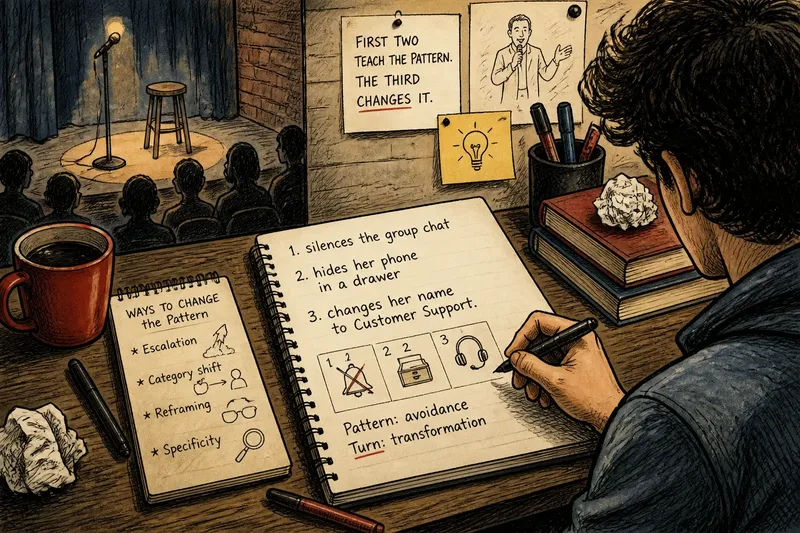
- Escalation: Two mild inconveniences lead to a consequence wildly out of proportion.
- Category shift: Two objects lead to a person, confession, or unexpected activity.
- Reframing: The third detail changes how the audience understands the first two.
- Specificity: Two broad observations lead to one oddly precise image that gives the pattern a sharper comic point.
These are options, not interchangeable tricks. Escalation is useful when the joke’s subject can support a bigger consequence. Reframing can work better when the humor comes from a character’s hidden motive. Choose the shift that grows out of the situation rather than adding a random oddity.
Imagine a writer describing a character who avoids answering messages: “She silences the group chat, hides her phone in a drawer, and changes her name to Customer Support.” The first two actions establish avoidance; the last turns it into a comic transformation. If the character’s problem is only that she dislikes notifications, the leap may feel detached. Give the setup enough context for the audience to understand why that escape is the joke.
How can you tell whether the pattern is clear?
Read the first two items aloud without the third. Ask a listener what kind of item they expect next, or write down your own prediction before finishing the list. The answer does not need to match your punchline exactly; it should reveal the track the setup has laid.
If the listener expects a third repair, food, or excuse, that gives you a pattern to bend. If they cannot tell what connects the first two, revise the pair before polishing the punchline. A strong third item cannot rescue a setup that has not created a recognizable direction.
Try removing extra explanation. If the audience needs a long account of why the first two items belong together, the relationship may be too private or complicated for a quick list. Add a short premise that makes the shared category visible, then let the three beats do their work.
Keep the setup clear enough to predict, but not so explicit that it announces the joke’s destination.
What should you revise when the third item falls flat?
Do not begin by making the final item louder or stranger. First check whether the earlier beats establish a stable pattern and whether the last beat actually changes it. A bizarre detail without a setup can sound like an unrelated fragment; a sensible continuation may simply confirm what the audience already expects.
- Check the category: Can you describe what the first two items have in common?
- Check the turn: Does the third item violate, enlarge, or reinterpret that category?
- Check the connection: Can the audience see why this particular turn belongs to the subject?
- Check the wording: Is the punchline’s important image or phrase easy to hear?
- Check the order: Would a less revealing first item preserve more surprise?
For a quick revision, draft several possible third items that use different kinds of change. One might escalate, another might expose a character’s motive, and another might swap the category. Compare them against the same first two beats. Keep the one that makes the setup feel purposeful rather than merely convenient.
Sometimes the best repair is to replace the second item. If it points toward the same destination as the punchline, the audience may arrive there early. A more ordinary or differently angled second beat can create a cleaner expectation for the third to disrupt.
Where does the rule of three fit in dialogue and performance?
On the page, the three items may look evenly balanced. In performance, timing and emphasis can make them feel quite different. The first item often needs a light delivery; the second can confirm the pattern; the third should make the turn easy to catch without underlining it with an added explanation.
In dialogue, the list can also reveal who is speaking. A meticulous character might build a neat progression, while an anxious one might leap to a disproportionate final possibility. The structure remains useful, but the choice of details and the speaker’s attitude supply the comic voice.
For sketch writing, a repeated list can develop across scenes if each return changes the stakes or meaning. Avoid repeating the same three-part joke with only new nouns. Let the audience recognize the structure, then give the next appearance a fresh turn that advances the character or situation.
In a stand-up set, a list can be a compact punchline or a bridge to a longer bit. Decide which job it has. If it is a bridge, the third item may open a new thought instead of ending the whole idea; make that transition feel intentional.
What questions help you shape a comic list?
Does every list of three need a surprising ending?
No. Three-part phrasing can create balance, emphasis, or clarity without aiming for a laugh. Use a comic turn only when it serves the joke, character, or scene.
Can the first two items be funny on their own?
They can have character or charm, but they should still prepare the audience for the third. If each item competes for attention, the list may feel like separate jokes rather than one built pattern.
Should the third item always be the longest?
No. A brief final item can land cleanly if its meaning is clear and the setup has prepared it. Length matters less than the contrast between the expectation and the turn.
What if the audience predicts the third item?
Strengthen the pattern’s misdirection or choose a different kind of change. You can also make the predictable item the setup for a further turn, provided the added beat remains clear and does not dilute the original joke.
How do you use the rule without making it mechanical?
Start with what the character wants to say, hide, or exaggerate. Then ask whether two details naturally establish a pattern and whether a third can reveal something sharper. If not, use another comic structure; a three-item list is a tool, not an obligation.
When revising, listen for the audience’s likely prediction rather than counting beats in the abstract. The rule of three in comedy works best when the first pair makes that prediction feel fair, and the last item gives the audience a reason to revise it. Build the expectation with care, and let the third beat change the thought—not just complete the count.