Your First Improvised Show: Watch for the Offer
Your first improvised show is easier to follow when you watch for each offer: the detail a performer adds and the way a scene partner responds.
Your first improvised show becomes easier to follow when you watch for the offer: each detail a performer adds and the response it invites. You do not need to guess the plot or spot the joke before it arrives. Track what enters the scene, then notice what the other performers do with it.
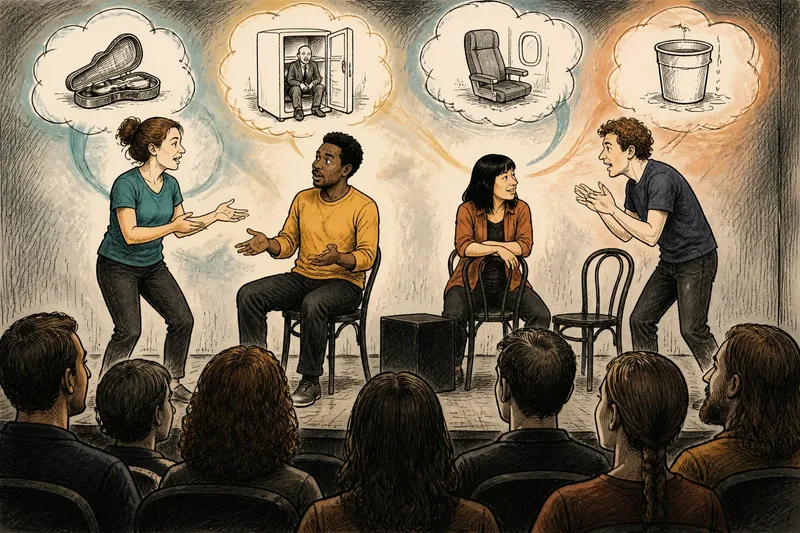
An offer might be a spoken fact, a movement, a relationship, or a change in the imaginary surroundings. A performer might say, “You packed my lunch in a violin case,” or silently hold out an invisible object. The audience’s job is not to decode a secret. It is to notice how the shared scene grows.
Why does the scene feel hard to follow?
A scene can seem confusing when you try to hold every line in memory or predict where the performers are headed. Improvisers often build from small, local choices rather than a destination announced at the start. A new detail can change the meaning of an earlier one, and a character’s behavior may clarify the situation before anyone explains it.
Instead, keep one simple question in mind: what has just been added? Listen for a name, an object, a place, a relationship, or a feeling. If a performer says, “Your mother called again,” the offer establishes a relationship and hints at a situation. The next response may confirm that hint, complicate it, or take the scene somewhere less expected.
Try following only the latest clear detail. Let the rest of the scene fill in around it.
What if a line sounds random?
A line can feel disconnected when it clashes with what came before, or when its connection is not clear yet. Sometimes the performer is making a deliberate turn; sometimes the scene simply has not shown you why the detail matters. You do not have to decide which explanation is right immediately.
Notice whether another performer accepts the detail and gives it a place in the scene. If someone mentions a leaky boat, a scene partner might grab an imaginary bucket, complain about the captain, or ask where the shore went. Each response gives the detail a different use. If nobody picks it up, let it pass and listen for the next offer rather than working to invent an explanation on the performers’ behalf.
Say you hear a character announce, “The mayor is in the refrigerator.” A partner could open the imaginary door and ask why the mayor is hiding. That response makes the odd statement part of the shared situation; the observable result is that the scene now has a hiding mayor and a reason to keep listening. You need not predict whether the scene becomes a mystery, a family argument, or something else.
Why do I lose track when several performers speak?
Fast exchanges can make every line seem equally important. Often, though, a scene becomes easier to read when you follow the performer who introduces a fresh fact or noticeably changes the situation. That offer may be verbal, such as naming a problem, or physical, such as placing an imaginary cake on a table.
Give your attention to the response as well as the offer. A partner might repeat a word, use the object, change their posture, or reveal a relationship through their reaction. Those choices show whether the new detail has become part of the scene. You can let a quick joke pass without losing the larger thread.
If you miss a line, do not try to reconstruct the whole exchange. Pick up the next clear action or detail.
What should I watch for when a scene shifts?
A shift may come from a new location, a change in time, a different relationship, or a sudden change in how a character behaves. It can feel abrupt if you are waiting for a formal announcement. Look for the offer that signals the change and for the partners’ responses, which can make the new frame legible.
An actor might turn a chair around and begin speaking as a flight attendant, while another performer moves into the role of a passenger. The chair, voice, and response together suggest a new setting. You do not need to decide whether the scene has ended; simply follow the active details and see which ones the performers keep using.
When a shift leaves you unsure, hold on to one concrete thing: who is speaking, what object is present, or what problem has just been named.
What if I laugh at a different moment than the room?
Audience reactions do not always arrive together. You may notice a small choice—a careful glance at an imaginary watch, for instance—before other people respond. Or a line that gets a laugh may also establish a relationship or a problem the scene will use later.
Let laughter be one signal, not a map of what matters. Keep watching what performers do after the laugh: do they repeat the detail, respond to it, or leave it behind? A joke can be both a moment of comic release and an offer that shapes the next exchange. If you do not laugh, the scene still has actions and relationships to follow.
What questions help you follow an improvised show?
What counts as an offer in improv?
An offer is a detail a performer gives the scene, such as a line, gesture, object, relationship, or change in circumstances. Other performers can accept it, adapt it, or leave it unused.
Do I need to understand every joke?
No. You can follow a character’s goal, the scene’s objects, and the way performers respond even when a joke does not land for you. Missing one laugh does not mean you have lost the whole scene.
Should I guess what happens next?
You can make a guess if it is fun, but prediction is not required. Watch what the performers add and how those additions change the scene in the moment.
What if I cannot tell whether the setting changed?
Look for a fresh physical or verbal detail, such as a character naming a place or treating a chair as a different object. If the change remains unclear, follow the relationships and actions that are easiest to see.
What can you do before the next scene starts?
Choose one point of attention instead of trying to read the whole performance at once. You might follow the imaginary objects, listen for changes in relationships, or watch how a performer answers a partner’s gesture. Switch your focus when it stops helping.
At your first improvised show, watching for the offer means attending to what performers actually share, not demanding a finished story before they have built one. Stay curious about the next response. That is often enough to keep a scene understandable while it is still becoming itself.